|
Relativity visualized
Space Time Travel |
![]() |
|
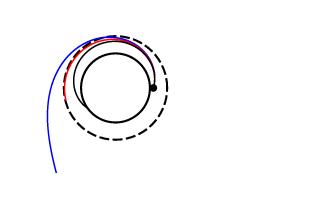
An observer (small black circular disk on the right)
looks towards a black hole (solid circle: the event horizon,
dashed circle: the circular photon orbit).
The observer sits at 5 Schwarzschild radii,
i.e. on a circle which is centered on the black hole and
has 5 times the circumference of the event horizon.
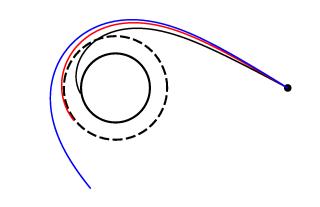
How big does the black hole appear to be? In order to see that, we retrace the paths of photons. If following the path backwards leads into the event horizon (black line), then no photons arrive on this path and the observer's sky is black in this direction. If the photon path passes by the black hole (blue line), photons from distant objects may reach the observer. The border between the sky and the black hole is given by the photon path that turns into the circular orbit (red line). |
|
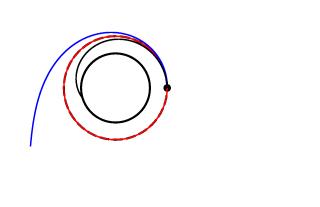
An observer closer to the black hole: at 1.5 Schwarzschild radii she is on the circular photon orbit. The border between photon paths coming from far away (blue) and photon paths coming from the black hole (black) is the circular path itself (red). The black hole covers exactly half of the observer's sky. |
|
An observer just outside the event horizon at 1.1 Schwarzschild radii. The border between photon paths coming from far away (blue) and photon paths coming from the black hole (black) is again given by the path that (followed backwards) turns into the circular photon orbit (red). This path reaches the observer from behind: The black hole covers more than half of the observer's sky. She therefore has the impression of being "engulfed" by the black hole, although she is still outside the event horizon. |
Contact: Would you like to be notified of new contributions or to send us a message?
Survey: How do you use this site and how would you like it to develop?